History of Robotics
Robots are Anthropomorphic
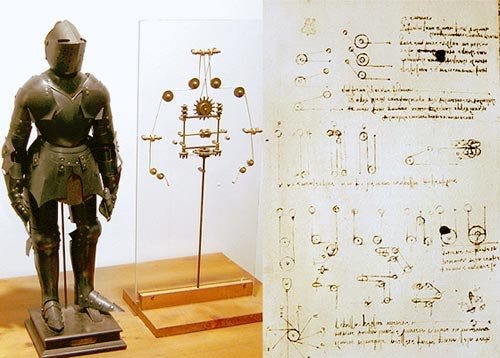
When you first think of a robot the instant image in a persons mind comes that of one with human form, this is not for no reason "A humanoid robot is a robot with its body shape built to resemble the human body. "(En.wikipedia.org, 2018) The reason behind the design of the robot is evident in history with Leanardo Davinchis "plans for a humanoid automaton resembling a medieval knight. With an anatomically correct jaw, and working movements ranging from standing, sitting, and moving its arms independently."(Medium, 2018) The purpose behind creating the robot would be to aid in production and increase human productivity and waste less time doing so, some may depict this as the eagerness of man trying to recreate himself in his own image, similar to god. As a result robots in most cases can be considered anthropomorphic, as even in movies their is either a utopia or dystopia surrounding robots and artificial intelligence and a sense of uncertainty.
Machine Learning:
Machine Learning can be described as "an application of artificial intelligence (AI) that provides systems the ability to automatically learn and improve from experience without being explicitly programmed."(Expertsystem.com, 2018) And with the boom of IoT and the vast amount of data that has been created there are multiple opportunities within commercial and industry to not only capitalise on but also more concerns with the security of this data that has been produced, in an article from the BBC it stated "2.5 exabytes - that's 2.5 billion gigabytes (GB) - of data was generated every day in 2012." (BBC News, 2018) and with the evolution of society into the digital age there is no doubt that the amount of data and information being produced everyday is no w in demand where as previously there was no demand. Despite their previously being no demand Machine Learning an Artificial Intelligence date back to the 20th century; a quote from Harvard University that summarises the history of ML & AI; "In the first half of the 20th century, science fiction familiarized the world with the concept of artificially intelligent robots." "Alan Turing, a young British polymath who explored the mathematical possibility of artificial intelligence. Turing suggested that humans use available information as well as reason in order to solve problems and make decisions"(Science in the News, 2018) It is with this that he went on to publish his paper in 1950, Computing Machinery and Intelligence in which he explores both how to build a AI machine and how to test their intelligence.
The below image is a flow chart to work out if something is Artificial Intelligence.
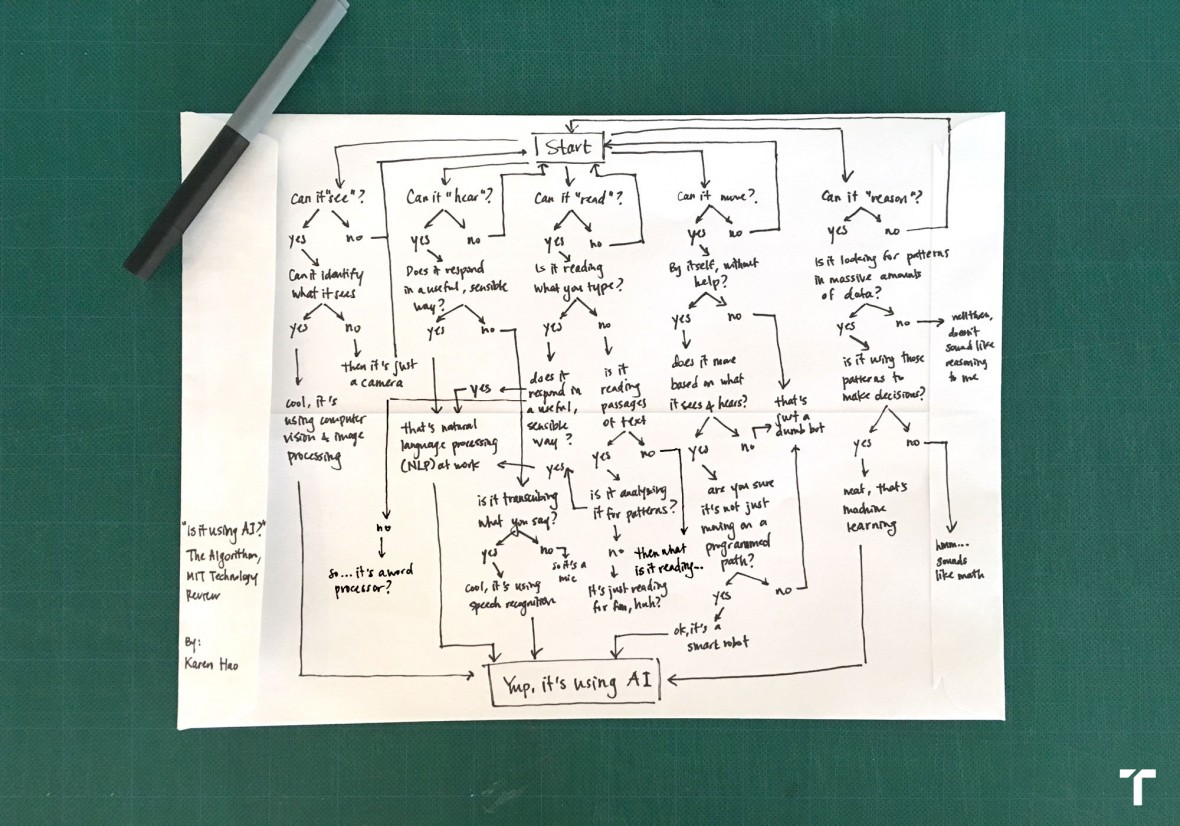
(Hao, 2018)
We are now at a stage where we can take machine learning to the next level with incorporating deep learning which is as described from MIT "Deep-learning software attempts to mimic the activity in layers of neurons in the neocortex, the wrinkly 80 percent of the brain where thinking occurs. The software learns, in a very real sense, to recognise patterns in digital representations of sounds, images, and other data." (Hof, 2018) The way in which AI and ML currently work together for example when we run a simulation we can see how a scenario would play out or even predict earthquakes, evacuation procedures, how to win a games etc. Incorporating Deep Learning would allow to replicate the human mind in machine form and then truly create AI that outperforms even the human brain, of course this will raise many ethical issues.
Machine Learning can be described as "an application of artificial intelligence (AI) that provides systems the ability to automatically learn and improve from experience without being explicitly programmed."(Expertsystem.com, 2018) And with the boom of IoT and the vast amount of data that has been created there are multiple opportunities within commercial and industry to not only capitalise on but also more concerns with the security of this data that has been produced, in an article from the BBC it stated "2.5 exabytes - that's 2.5 billion gigabytes (GB) - of data was generated every day in 2012." (BBC News, 2018) and with the evolution of society into the digital age there is no doubt that the amount of data and information being produced everyday is no w in demand where as previously there was no demand. Despite their previously being no demand Machine Learning an Artificial Intelligence date back to the 20th century; a quote from Harvard University that summarises the history of ML & AI; "In the first half of the 20th century, science fiction familiarized the world with the concept of artificially intelligent robots." "Alan Turing, a young British polymath who explored the mathematical possibility of artificial intelligence. Turing suggested that humans use available information as well as reason in order to solve problems and make decisions"(Science in the News, 2018) It is with this that he went on to publish his paper in 1950, Computing Machinery and Intelligence in which he explores both how to build a AI machine and how to test their intelligence.
The below image is a flow chart to work out if something is Artificial Intelligence.
(Hao, 2018)
We are now at a stage where we can take machine learning to the next level with incorporating deep learning which is as described from MIT "Deep-learning software attempts to mimic the activity in layers of neurons in the neocortex, the wrinkly 80 percent of the brain where thinking occurs. The software learns, in a very real sense, to recognise patterns in digital representations of sounds, images, and other data." (Hof, 2018) The way in which AI and ML currently work together for example when we run a simulation we can see how a scenario would play out or even predict earthquakes, evacuation procedures, how to win a games etc. Incorporating Deep Learning would allow to replicate the human mind in machine form and then truly create AI that outperforms even the human brain, of course this will raise many ethical issues.
Machines working raises ethical issues such as how much should you really be paid if AI is doing all the hard work? or then are you paid for your interpretation and ideation rather than creation? All things we must take into consideration with AI fast approaching in every day life in the form of Alex, Youtube, Google and more leading the way with DL; "Google in particular has become a magnet for deep learning and related AI talent."(Hof, 2018) We also see ethical issue becoming more apparent with the first citizenship granted to a robot in Dubai 'Sophia', many people argue both for an against the rights of robots and artificial intelligence such as who will be liable for any damages caused by artificial intelligence? The creator or the AI.
Types of Machine Learning
As described by Tom Mitchell in his book Machine Learning; "Machine learning is the study of computer algorithms that improve automatically throughout experience"(Mitchell, 2017) - Machine learning algorithms are generally categorised as supervised or unsupervised. View the below extract from an article detailing the types of machine learning:
- "Supervised machine learning algorithms can apply what has been learned in the past to new data using labeled examples to predict future events. Starting from the analysis of a known training dataset, the learning algorithm produces an inferred function to make predictions about the output values. The system is able to provide targets for any new input after sufficient training. The learning algorithm can also compare its output with the correct, intended output and find errors in order to modify the model accordingly.
- In contrast, unsupervised machine learning algorithms are used when the information used to train is neither classified nor labelled. Unsupervised learning studies how systems can infer a function to describe a hidden structure from unlabelled data. The system doesn’t figure out the right output, but it explores the data and can draw inferences from data sets to describe hidden structures from unlabelled data.
- Semi-supervised machine learning algorithms fall somewhere in between supervised and unsupervised learning, since they use both labelled and unlabelled data for training – typically a small amount of labelled data and a large amount of unlabelled data. The systems that use this method are able to considerably improve learning accuracy. Usually, semi-supervised learning is chosen when the acquired labelled data requires skilled and relevant resources in order to train it / learn from it. Otherwise, acquiring unlabelled data generally doesn’t require additional resources.
- Reinforcement machine learning algorithms is a learning method that interacts with its environment by producing actions and discovers errors or rewards. Trial and error search and delayed reward are the most relevant characteristics of reinforcement learning. This method allows machines and software agents to automatically determine the ideal behaviour within a specific context in order to maximise its performance. Simple reward feedback is required for the agent to learn which action is best; this is known as the reinforcement signal.
Machine learning enables analysis of massive quantities of data. While it generally delivers faster, more accurate results in order to identify profitable opportunities or dangerous risks, it may also require additional time and resources to train it properly. Combining machine learning with AI and cognitive technologies can make it even more effective in processing large volumes of information."
(Expertsystem.com, 2018)
Supervised learning (Classification algorithm) - Supervised learning is the machine learning task of learning a function that maps an input to an output based on example input-output pairs. It infers a function from labeled training data consisting of a set of training examples.
Unsupervised Learning (Clustering algorithm) - We can cluster things incorrectly, e.g. sample sizes. Unsupervised learning is a branch of machine learning that learns from test data that has not been labelled, classified or categorised.
Machine learning is the study of computer algorithms that improve automatically throughout experience - Tom Mitchell machine learning mcgraw hill, 1991.
Heating/Air con uses carbon and energy - machine learning supervised learning, this type of machine learning is where algorithms try to model relationships and find the best possible solution to maximise resources and keep costs low.
Comments
Post a Comment